By Dana Armstrong
America does not have a food problem because we have forgotten how to grow food.
We know how to grow it. We know how to raise livestock. We have some of the richest agricultural land on Earth, generations of farming knowledge and an agricultural industry capable of producing food on an extraordinary scale.
Yet Americans are paying painful prices at the grocery store. Food banks struggle to meet demand. Usable food is discarded. Our cattle inventory continues to shrink. Rural communities are losing food-animal veterinarians. And the United States now imports substantially more agricultural products by value than it exports.
At some point, we should ask an uncomfortable question:
When did American agriculture stop being primarily about making it easier for American farmers to feed American people?
I run a small nonprofit farm in Alaska. We raise livestock, poultry and produce, much of it intended for families who need food.
That sounds simple.
Grow food. Raise animals. Feed people.
Living inside America’s food system has taught me that we have managed to make those four words remarkably complicated.
We Have Built a Food System Around Waste
An Alaska dairy farmer once told me something I haven’t forgotten.
Sometimes it made more economic sense for the farm to dump milk than to donate it.
Think about that.
Not because the farmer wanted to waste food. Not because nobody needed the milk. But because milk doesn’t magically travel from a cow to a family’s refrigerator. It has to be handled, processed, stored and transported through a highly regulated, extremely time-sensitive supply chain.
The federal government itself recognizes that donating milk can impose costs. USDA operates a Milk Donation Reimbursement Program through which eligible dairy organizations and nonprofit distributors can receive limited reimbursement for certain expenses associated with donated fluid milk.[1]
Meanwhile, the Environmental Protection Agency estimates that 30 to 40 percent of the U.S. food supply is never eaten.[2]
We have become so accustomed to food waste that numbers like that barely shock us anymore.
They should.
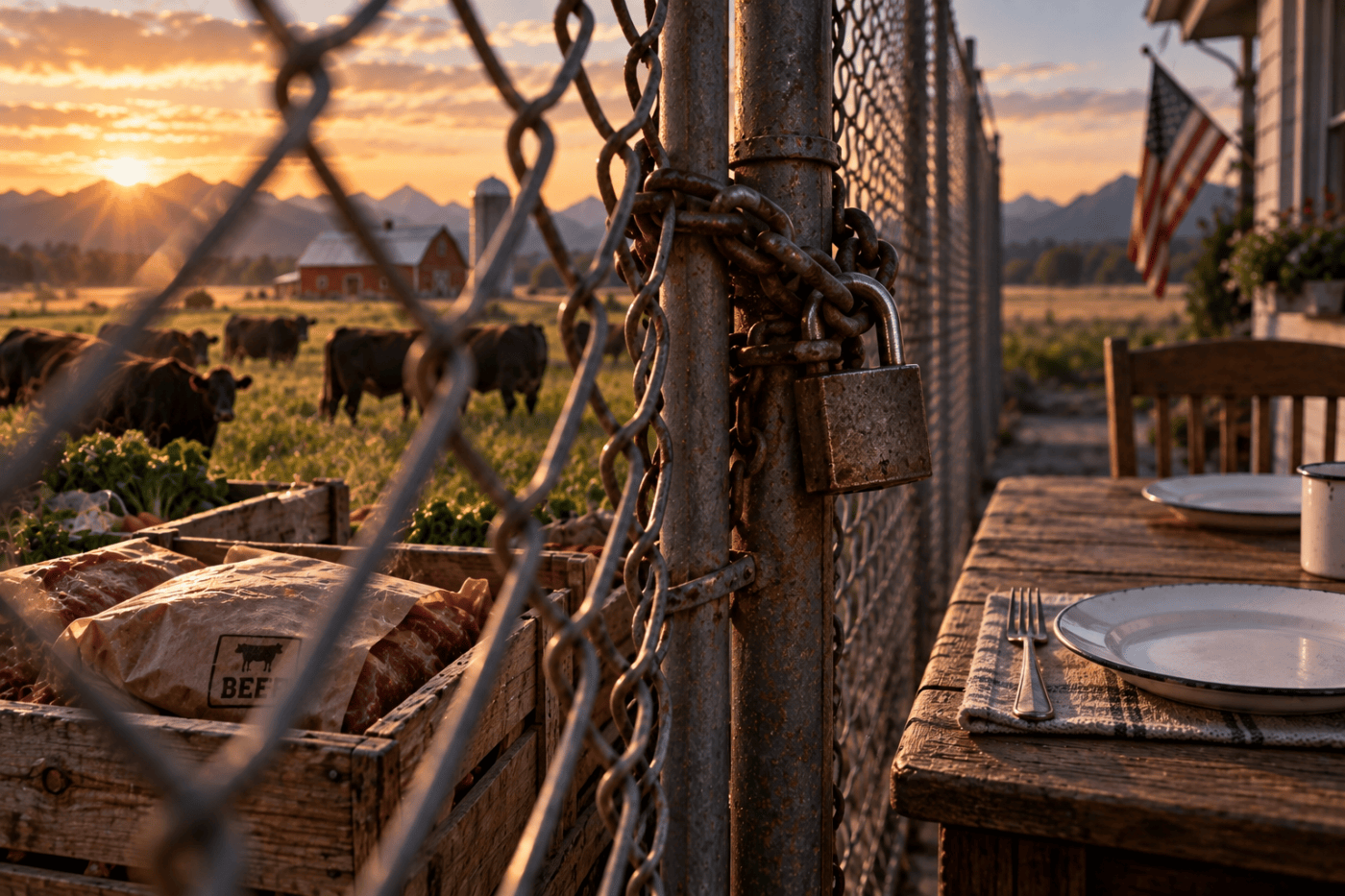
We have built a food system in which disposing of food can sometimes be easier than getting that food into the hands of someone who needs it.
That isn’t a failure of American farmers.
It is a failure of the system surrounding them.
Look at What We’re Growing
Drive through America’s farm country and you’ll see corn stretching seemingly forever.
It looks like food security.
But most of that corn isn’t being grown for people to eat directly.
USDA says livestock feed typically accounts for about 40 percent of total domestic corn use. Food, seed and industrial uses account for most of the remainder, with fuel ethanol by far the largest industrial use. USDA has separately estimated that ethanol and its related co-products use about 40 percent of the U.S. corn crop.[3]
Corn has been livestock feed for generations. Field corn is not simply millions of acres of sweet corn that could be redirected to grocery stores tomorrow.
But something significant did change.
Between 2000 and 2009, U.S. ethanol production exploded from 1.6 billion gallons to 10.8 billion gallons, almost all of it produced from corn. USDA researchers found that while some of the additional corn came from increased yields and some was diverted from other uses, much of the additional supply came from expanding planted acreage. Federal bioenergy policies and energy prices helped drive that demand.[4]
America didn’t stop farming.
We changed what farming was economically rewarded for producing.
At the same time, something else remarkable happened.
For decades, the United States generally exported more agricultural products by value than it imported. Today, that balance has shifted sharply in the opposite direction.
In 2025, U.S. agricultural exports were worth about $171 billion, while imports reached approximately $212 billion—a difference of roughly $41 billion.[5]
That does not mean America imports more food than it produces. Trade value and domestic food production are entirely different measurements, and the United States remains an agricultural powerhouse.
Some imports also make obvious sense. Americans want coffee, cocoa, tropical products and fresh produce during seasons when domestic production cannot economically supply everything we consume.
But the trend deserves our attention.
We are an agricultural superpower increasingly buying agricultural products from the rest of the world while devoting enormous domestic resources to producing feed and fuel.
Perhaps we should at least ask whether our incentives still match our priorities.
Then Look at the People Raising Our Meat
America wants affordable beef.
There’s just one little problem.
We need cattle—and people willing and able to raise them.
USDA counted 86.2 million cattle and calves on American farms on January 1, 2026. The beef-cow herd stood at 27.6 million head, down another one percent from the previous year. The 2025 calf crop was also estimated to have fallen two percent.[6]
But simply telling ranchers to raise more cattle ignores what it actually takes to keep livestock healthy.
Across rural America, producers are struggling to find food-animal veterinarians.
This isn’t anecdotal.
USDA formally designates veterinary shortage areas and operates programs intended to attract veterinarians to underserved agricultural communities.
Some of USDA’s own shortage descriptions are astonishing.
In one critical veterinary shortage area covering nine counties in northwest Iowa—hardly a place unfamiliar with livestock—USDA reports more than 5.1 million livestock and an average of approximately 106,527 animals per food-animal veterinarian. The number of practicing food-animal veterinarians there has fallen almost 15 percent since 2020.[7]
Now consider what has happened simultaneously with animal-health policy.
Medically important animal antibiotics that were once available over the counter have been moved under veterinary oversight. FDA’s Guidance for Industry #263 was proposed in 2019 and fully implemented in June 2023. FDA reports that affected manufacturers either changed their products from over-the-counter to prescription status or withdrew the affected OTC approvals, meaning affected products entering the marketplace now carry prescription labeling.[8]
That policy crossed presidential administrations.
This is not a Republican problem.
It is not a Democratic problem.
It is an American agriculture problem.
We have created a remarkable contradiction: federal policy increasingly requires veterinary involvement in obtaining medically important livestock antibiotics while the federal government’s own data document communities where food-animal veterinary care is desperately scarce.
Responsible antibiotic stewardship matters.
So does having a veterinarian available when an animal actually needs one.
And Then There Is Processing
The farmer doesn’t control the entire journey from pasture to supermarket meat case.
America’s beef-processing industry is extraordinarily concentrated. USDA’s Economic Research Service reports that the four largest firms handle 85 percent of all steer and heifer purchases.[9]
Concentration does not by itself prove illegal behavior. But it creates legitimate questions about competition, and those questions are receiving federal attention.
The Justice Department said in July 2026 that its investigation into the nation’s largest meatpacking companies for potential collusion, price fixing and price manipulation was “well under way.” Those are matters under investigation—not findings of wrongdoing.[10]
And on September 4, 2026, President Donald Trump signed an executive order aimed at increasing competition in livestock markets and expanding market access for American meat producers. Among other things, the order directs USDA to examine barriers affecting smaller processors and custom-exempt operations and to pursue greater market access while maintaining food-safety standards.[11]
Whatever ultimately comes from that effort, the underlying problem is difficult to ignore.
For the small producer, today’s rules can lead to an almost absurd result.
A farmer can slaughter his own steer under the federal personal-use exemption and feed that meat to his household and nonpaying guests.
But he cannot take meat produced under that exemption and simply give it to a hungry family.
USDA’s Food Safety and Inspection Service explicitly says livestock or poultry slaughtered and processed under the personal-use or custom exemption cannot be donated. Federal law restricts that product to the owner, members of the owner’s household, nonpaying guests and employees.[12]
Read that again.
You can raise the animal.
You can feed the animal.
You can butcher the animal.
You can eat the animal.
But if your neighbor’s children are hungry, meat produced under that exemption cannot simply be handed across the fence.
Food safety matters. Inspection matters.
But surely we can acknowledge the absurdity of a food system in which feeding your neighbor can sometimes be legally more complicated than feeding yourself.
Feeding People Should Not Be This Complicated
I don’t believe the answer is eliminating food-safety standards.
Nobody wants contaminated meat. Nobody wants unsafe milk. Nobody benefits from antibiotics being used recklessly.
But somewhere between sensible safeguards and today’s enormous agricultural system, we seem to have forgotten what all of this is ultimately supposed to accomplish.
Feed people.
I see the disconnect from an unusual position.
I’m a farmer, but I also run a nonprofit whose purpose is getting farm-produced food to people who need it.
That means I see both ends of the chain.
I see what it costs to raise the animal.
I see what happens when veterinary care isn’t readily available.
I see the processing problem.
I see transportation costs.
And then I see the family at the other end who couldn’t care less about agricultural policy.
They just need dinner.
America doesn’t need another complicated program designed to fix the complications created by the last complicated program.
We need to start asking a much simpler question of every agricultural policy we create:
Does this make it easier or harder for American farmers to feed American people?
Protect food safety.
Protect animal welfare.
Use antibiotics responsibly.
Protect competition.
But protect the farmer, too.
Because food security doesn’t begin at Walmart.
It doesn’t begin at a food bank.
And it certainly doesn’t begin in Washington.
It begins with someone willing to put a seed in the ground or an animal in a pasture and spend months turning it into food.
America didn’t forget how to farm.
We made farming harder than it needs to be.
Maybe instead of asking farmers to somehow produce more within the system we’ve built, we should finally ask a different question:
What would happen if we made feeding people the priority again?
Sources & Notes
[1] USDA Agricultural Marketing Service — Milk Donation Reimbursement Program. Eligible dairy organizations and nonprofit distributors may receive limited reimbursement for certain expenses associated with donated fluid milk.
USDA — Milk Donation Reimbursement Program
[2] U.S. Environmental Protection Agency — Food Loss and Waste. EPA estimates that 30–40% of the U.S. food supply is never eaten.
EPA — U.S. Food Loss and Waste Reduction Goal
[3] USDA Economic Research Service — Corn and Other Feed Grains. ERS reports livestock feed typically accounts for about 40% of domestic corn use; ethanol represents another enormous component of corn demand.
USDA ERS — Feed Grains Sector at a Glance
[4] USDA Economic Research Service — Ethanol Expansion. U.S. ethanol production rose from approximately 1.6 billion gallons in 2000 to 10.8 billion in 2009, overwhelmingly using corn.
USDA ERS — Where Did the Corn Come From?
[5] USDA Economic Research Service — Agricultural Trade. USDA’s data show approximately $171 billion of agricultural exports versus $212 billion of imports in 2025.
USDA ERS — International Markets and U.S. Trade
[6] USDA National Agricultural Statistics Service — Cattle, January 2026. USDA reported 86.2 million cattle and calves, including 27.6 million beef cows.
USDA NASS — January 2026 Cattle Inventory
[7] USDA National Institute of Food and Agriculture — Veterinary Shortage IA257. USDA classifies this northwest Iowa region as a critical food-animal veterinary shortage.
USDA NIFA — IA257 Veterinary Shortage
[8] U.S. Food and Drug Administration — Guidance for Industry #263. FDA transitioned remaining affected medically important animal antimicrobials from OTC to veterinary prescription status.
FDA — Antimicrobial Resistance Action Timeline
[9] USDA Economic Research Service — Meatpacking Concentration. USDA reports the four largest firms handle approximately 85% of steer and heifer purchases.
USDA ERS — Concentration in U.S. Meatpacking
[10] U.S. Department of Justice — R-CALF USA remarks, July 2026. DOJ stated its investigation concerning potential collusion, price fixing and price manipulation among major meatpackers was underway; this does not establish wrongdoing.
Department of Justice — 2026 R-CALF USA Remarks
[11] The White House — September 4, 2026 Executive Order. The order concerns livestock-market competition and expanding market access for American meat producers.
White House — Livestock Markets Executive Order
[12] USDA Food Safety and Inspection Service — Personal/Custom-Exempt Donation. FSIS states that livestock or poultry processed under the personal-use or custom exemption cannot be donated.
USDA FSIS — Custom and Personal-Use Donation Rule
 Eden's Edge
Leave a comment